Why Your Raid Partner Understands Your Meltdowns Better Than Anyone With a License
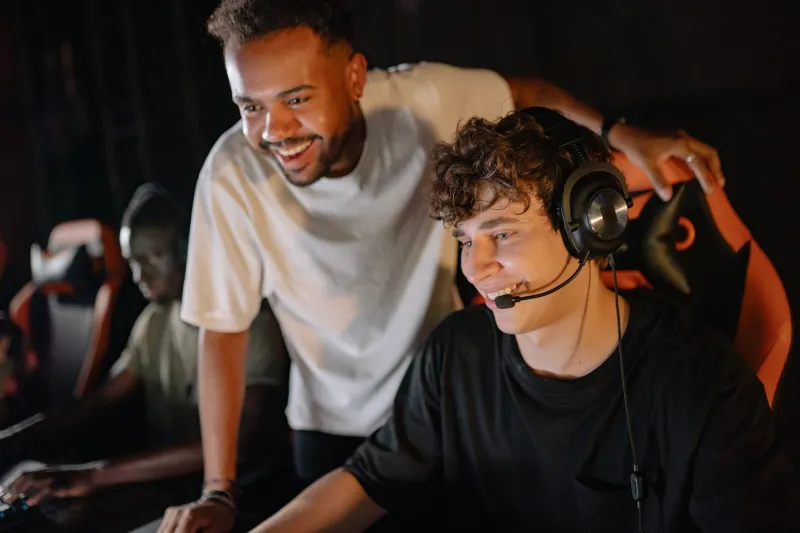
It's 11:47 PM on a Tuesday. You've just wiped on the same boss for the fourth time, your headset is digging into your ear, and somehow — somewhere between respawning and regrouping — you've started talking about the fight you had with your mom three weeks ago. Your raid partner, someone you've technically never met in person, just said exactly the right thing.
No credentials. No sliding scale. No "and how does that make you feel?"
Just a guy named DarkViper99 who somehow nailed it.
This isn't a fluke. It's a pattern that researchers, players, and even a few actual therapists are starting to pay serious attention to.
The Side Door Into Your Own Head
Here's the thing about traditional therapy: it puts you on the spot. You walk in, sit down, and the entire point of being there is to talk about yourself. For a lot of people, that pressure is enough to make them shut down before they've even started. The vulnerability is front and center, which is exactly what makes it hard.
Gaming flips that dynamic entirely.
When you're focused on a task — clearing a dungeon, surviving a match, coordinating a heist — your brain's threat response chills out. You're occupied. You're not sitting across from someone whose entire job is to analyze what you say. The conversation that happens around the game becomes almost incidental, which is precisely why it flows so freely.
Dr. Rachel Kowert, a research psychologist who has spent years studying the intersection of gaming and mental health, has described this as the "side door" effect. Players access emotional content through a kind of indirect route — the game gives them something to focus on, and the real conversation sneaks in through the back.
In plain terms: it's easier to admit you're struggling when you're also busy trying not to get headshot.
Parallel Play, But Make It Adult
If you've ever watched toddlers interact, you've seen parallel play — two kids doing their own thing side by side, occasionally connecting, but never fully face-to-face. Child development experts consider it a crucial early stage of social bonding. It turns out adults never really outgrow the need for it.
Gaming is basically parallel play with a headset and a kill streak.
Sitting across from someone and maintaining eye contact while you talk about anxiety, loneliness, or the fact that your job is making you miserable is genuinely hard. But doing those same tasks while your eyes are both fixed on a screen? The pressure drops significantly. The absence of direct eye contact removes a layer of social performance that a lot of people find exhausting.
Players describe this constantly. A guy in a Reddit thread about gaming and mental health put it bluntly: "I've told my Warzone squad stuff I've never told my actual friends. Something about the game just makes it easier to say things out loud."
That's not an accident. That's psychology doing its thing.
The Trust That Builds in the Trenches
There's also something to be said for the kind of trust that forms specifically inside games. When you've carried someone through a rough match, bailed them out of a bad situation, or just stayed in the party chat when they were venting instead of bailing — that builds something real.
Gaming relationships earn credibility through doing, not just talking. Your raid partner has seen you frustrated, defeated, triumphant, and embarrassingly bad at something you claimed to be good at. There's a particular kind of intimacy in that shared history, even if it's entirely digital.
By the time someone in your squad brings up something heavy — a breakup, a job loss, a family situation that's gotten complicated — the relationship already has weight behind it. The trust was built during a hundred low-stakes moments, which makes the high-stakes ones feel less terrifying to navigate.
What Gaming Buddies Do That Therapists Can't
To be clear: this isn't an argument against therapy. Actual licensed therapists provide something structured, trained, and clinically valuable that a Discord call simply cannot replicate. If you're dealing with serious mental health challenges, please talk to a professional.
But gaming friendships fill a gap that therapy — by design — doesn't cover.
Therapy is scheduled. It's formal. It exists in a dedicated space that signals "this is serious." Gaming support is ambient. It's available at 11 PM when something is eating at you. It doesn't require an appointment or a copay. It shows up in the middle of a match when you're already talking, and it responds in real time with someone who actually knows your life.
There's also no power dynamic. Your gaming buddy isn't there to guide you toward insight — they're just there. Sometimes that's exactly what someone needs: not an expert, but a witness. Someone who says "yeah, that sounds genuinely awful" without immediately pivoting to coping strategies.
The informality is the whole point.
The Limits (Because There Are Always Limits)
For all its genuine value, the gaming-as-therapy phenomenon has real edges. The support is inconsistent — your squad might be great listeners one night and completely unavailable the next. There's no continuity, no framework, and no training. A well-meaning friend can say the wrong thing, and without professional guidance, some conversations can spiral in unhelpful directions.
There's also the question of reciprocity. Therapy is a one-way street by design, which protects both parties. Gaming friendships are mutual, which means emotional labor gets distributed unevenly sometimes. If one person in a squad becomes the group's de facto emotional support without that being acknowledged, it can quietly wear them down.
The healthiest version of this is probably what most people already intuitively do: use gaming friendships for the ambient, organic support they're genuinely good at, and lean on professional resources when things get heavy enough to need them.
The Real Flex Is Letting People In
What's most interesting about all of this isn't the psychology — it's what it says about how people actually connect. Humans are wired for community, but a lot of traditional structures for building it have weakened or disappeared. Church attendance is down. Bowling leagues are basically a joke now. Third places — those non-work, non-home spaces where people used to gather — have been shrinking for decades.
Gaming filled that gap almost without anyone noticing. Party chats and Discord servers became the new back porch. Raid nights became the new standing Friday plans. And somewhere in all that, people started showing up for each other in ways that matter.
DarkViper99 isn't your therapist. But he showed up at 11:47 PM on a Tuesday when you needed someone to talk to, and he said exactly the right thing.
Sometimes that's the whole game.